
Decarbonizing Data Centers Pt. II
How innovative data centers are keeping temperatures down.

Data centers are hotter than ever.
As we found in Part I, cooling these massive heat-producing complexes plays a key part in managing overall emissions. In an average data center, the cooling system is second only to the servers in terms of energy consumption (cooling systems account for roughly 40% of a data center’s energy usage, while servers hold a narrow lead with 44% of a center’s energy usage). I’ve seen plenty of (well-meaning) articles touting responsible cooling management as the way to decarbonize data centers. But what does that actually mean?

I want to go beyond the vague concept of ~responsible management~ and actually understand what tactics are being put to the test by innovative designers, scientists, and operators to maximize cooling while minimizing emissions. To put my question simply—
What are we actually doing about this?
To start, it’s helpful to categorize efforts at cooling improvements into two buckets:
Bucket one: using cooling sources that can either supplement or fully replace traditional air conditioning systems
i.e. air-side free cooling which utilizes cool outdoor air, water-side free cooling which directly transfers heat to a cooler tower, bypassing the need for mechanical chiller compressors, evaporative cooling which pulls hot, dry air over water-drenched pads, etc.)
Bucket two: energy efficiency improvements
i.e. improvements to airflow management, innovative waste heat recovery methods, cooling equipment optimization, etc.
As it turns out there is plenty of innovation going on in the data center cooling space. Not only is there plenty of opportunity for creativity, but optimization of cooling represents a major cost savings lever that, unsurprisingly, is generating a great deal of interest. After all, as previously mentioned, the cooling system in a typical data center is second only to the servers as the biggest source of electricity consumption, coming in at 40%. The examples of cooling innovations I found the most compelling—and explore below—predominantly fall into bucket two, and specifically in the category of waste heat recovery.
Quick waste heat recovery primer before we begin.
Waste heat recovery (WHR) represents a major source of untapped potential for both energy and cost savings.
The waste heat that can be recovered from data centers is typically low grade heat, meaning heat below ~100°C.
Waste heat from liquid cooling methods is generally of higher temperature (higher grade) than waste heat from air cooling and therefore has better potential for reuse in industrial or data center applications.
Waste heat can be recovered from many sources, including exhaust, coolants, and circulating liquids, and using various methods, including a multiple types of heat pumps and supported by thermal energy storage.
Waste heat can be recovered and reused in a variety of applications, including in the local residential heating networks, district heating networks, cooling production including absorption, adsorption, and evaporative cooling, industrial processes, agricultural processes, desalination, etc.
Below are some of the standout examples of heating/cooling protection and waste heat recovery/reuse I’ve found thus far (in no particular order):
Helen’s Heat Capture in Helsinki
Helen is one of Finland’s largest and most important energy companies. Underneath the streets of Helsinki, they have a major operation recapturing heat from data centers and funneling it into power and energy for Helsinki residents.
Here’s how it works: the heat that emanates from nearby data centers is piped into Helen’s utility system via heat pumps where, after the temperature is raised even more, it is funneled into the Helsinki district heating network, providing energy for the city. Helsinki returns cooled water to Helen’s system, which then pipes that water back to the data centers for reuse.
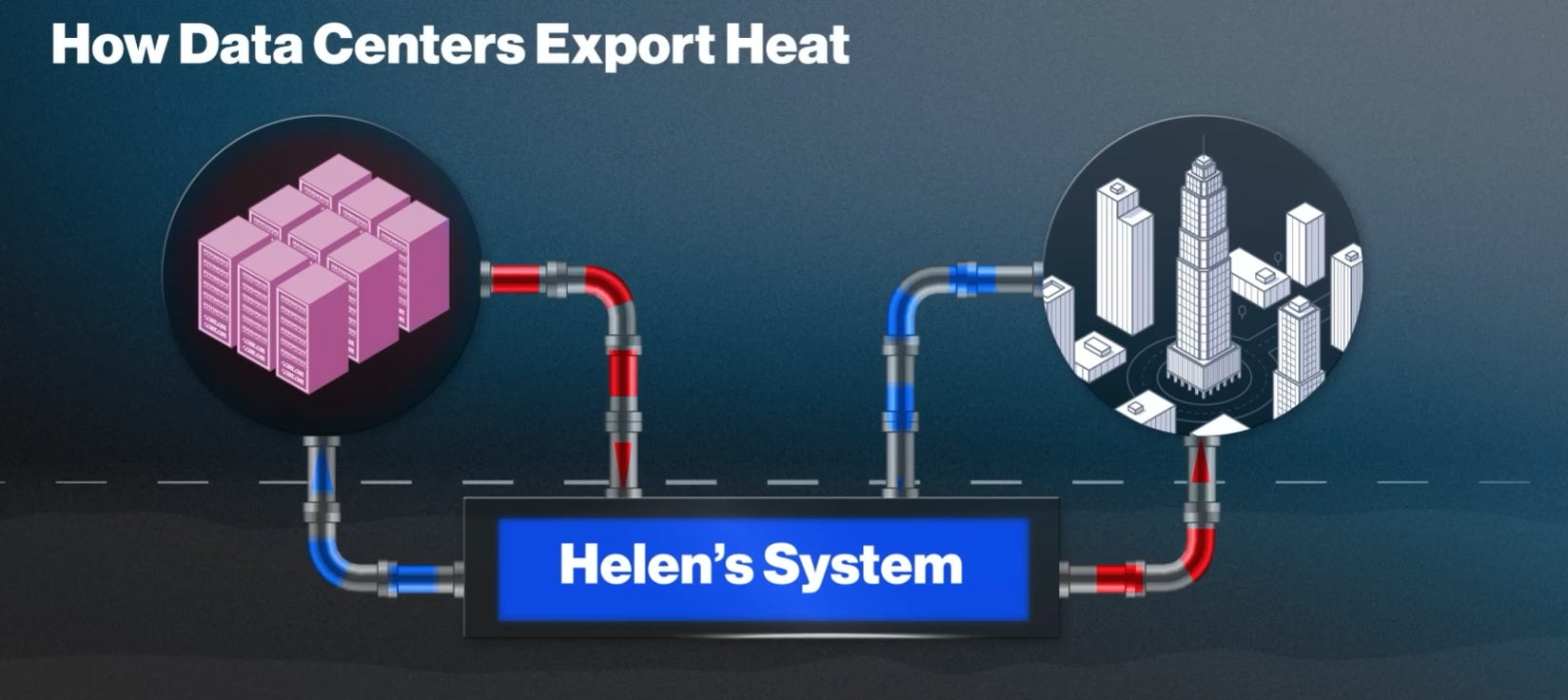
Olli Sirkka, the CEO of Helen, highlights the practicality of this set-up, noting that this circular solution provides data center companies like Equinix with a cost-effective solution to their biggest and most expensive problem: heat.
Helen’s model for waste heat recovery has proven to be successful— electricity prices in Finland sit below the EU average. This is significant, because according to a Bloomberg Technology report, in areas located in close proximity to large data centers, electricity costs up to 267% more per month than it did in 2020. This model demonstrates a financial win both for residents and for Helen and their data center partners.
NLR’s Energy Systems Integration Facility (ESIF)
National Laboratory of the Rockies, or NLR (formerly National Renewable Energy Laboratory, or NREL) is a massive research hub in Golden, Colorado, home to the nation’s premier lab for energy, the 182,000 square foot Energy Systems Integration Facility (ESIF). (Though the current administration has removed ESIF’s sustainable attributes from the government webpage, it should be noted that ESIF is a LEED Platinum facility that, when built in 2013, was specifically “renowned for its commitment to green building construction”).
ESIF is a leader in data center innovation for many reasons, first and foremost being its chiller-free design thanks to warm-water liquid cooling and Colorado’s semi-arid climate. The facility uses warm water (up to 75°F) in its liquid cooling processes, eliminating the need for mechanical chillers in favor of evaporative cooling towers. This represents huge CapEx (capital expenditure) and OpEx (operating expenses) savings.
A little background on liquid cooling and why this matters:
Below are the average temperatures of water in liquid cooling systems:
Standard data centers: 42-45°F / 6-7°C
Data centers optimized for cooling: 50°F / 10°C (or higher)
Roughly every 1.8°F/1°C increase in water temperature saves approximately 2-3% in power consumption, per Johnson Controls. But as computing chips increase in density, the heat they emanate also increases, necessitating a decrease in water temperature for direct liquid cooling. Therein lies a dilemma; how do we balance cooling optimization with total facility efficiency?
Historically, many data center operators err on the side of caution, seeking to over-cool their servers to minimize heat-related risks. This leads to more energy (and money) consumed in the name of air cooling and, increasingly, liquid cooling. Conversely, there is also the opposite issue of raising water temperatures too high which, though excellent for PUE because of lower energy usage, risks overheating complications. Striking a balance between competing needs is the overwhelming challenge in front of data center leadership. ASHRAE, the American Society of Heating, Refrigerating, and Air-Conditioning Engineers, established guidelinesEditSign (first in 2011, then updated several times, most recently in 2024) that set standards and recommended limits for liquid cooling temperatures.
Why else is NLR’s ESIF noteworthy?
Data center heat capture and reuse
Thermosyphon cooler
Industry-leading low PUE and instantaneous PUE calculations
Reflective Paint
This one is so straightforward that it stopped my in my tracks. By simply painting reflective or thermally-insulating coatings onto roofs or exterior walls, companies can significantly reduce the strain of cooling on their data centers. It’s that simple.
A study of heat-reflective paint on large facilities in India found that reflective coatings can reduce the roof surface temperature by 25-30°C, drastically reducing OpEx.
Different coatings offer a variety of protections.
Thermally insulating coatings effectively establish a barrier layer between the building and the source of heat, minimizing building heat absorption.
Reflective coatings deflect heat away from the building and reduce the HVAC strain on a data center.
So why aren’t all data centers doing this?

Greenhouse Heating
As of 2021, over 90% of vegetables consumed by Swedes were imported, a portion far too high for the government’s liking. In the spirit of cultivating greater nutritional independence, Sweden focused on a local food initiative with the aim to bolster local farms, boost production, and enable increased self-sufficiency (a major goal of the Swedish government). But this wasn’t a target with a straightforward path—greenhouses used to grow produce in northern Sweden require year-round heating, so energy consumption and costs are high. A study in 2021 explored the feasibility of recovering waste heat from data centers to use as the primary heat source for these greenhouses.
In their test case using the waste heat from Boden Type One Data Center (BTDC) to provide heating for the greenhouse Hietala Trädgård that grows tomatoes, cucumbers, and other flowering plants, this experiment found that over 30% of a 1 MW data center’s annual electricity input could be recovered effectively. Though it must be noted that this study operated under a number of assumptions, including cost of heat recovery (low) and proximity of greenhouses to data centers, this finding represents the type of solutions that can be unlocked with creative thinking to solve multiple problems—in this case a sustainability issue and an agricultural challenge—in one fell swoop.

I barely scratched the surface.
There is a lot more to explore here—successful case studies, creative applications, ideas for future progress. If you’d be interested in a part II of real world heating/cooling examples like this, let me know! But for now, we’ll close this chapter and move onto water. Stay tuned.