
Fish and Chips
An idea so outlandish that it's under water.

Maybe Sebastian was onto something.

Is going ~under the sea~ the answer to our data center sustainability woes?
In 2014 during Microsoft’s ThinkWeek, an internal event that they host to generate creative ideas from employees, two Microsoft engineers named Sean James and Todd Rawlings began circulating an unconventional idea. They pitched putting data centers under the sea to reduce cooling and construction costs, use renewable energy sources, and improve data center performance. A testament to the adage “right time, right place,” this proposition caught the attention of Norm Whitaker at Microsoft, who began to assemble a team to bring this vision into reality.
What started as an unorthodox idea has, for the last ~12 years, been gaining traction. In 2015, Microsoft became the first group to officially pilot a full-scale test of underwater data centers (UDCs) with their Project Natick (Phase I). This evolved into a Phase II, and several other companies have followed suit.
And what was the result of this experiment? Microsoft deemed it a success. They found that servers in their UDC (which they dubbed the Leona Philpot) were “substantially more reliable” than those housed in terrestrial data centers, the server failure rate just 1/8th of what it is on land. The data center did not consume additional water for cooling and proved that it would be possible to create a true zero-emission facility (when connected to offshore renewable energy sources).
So if this was such a success, why aren’t more data centers going for swims?
Let’s take a step back. Before we really dive into the benefits, drawbacks, and current examples of installing data centers on the seafloor, let’s answer this question: what are underwater data centers, really?
UDCs, like Project Natick’s Leona Philpot, are sealed steel pods that can hold several thousand servers, keeping their contents dry and safe. These vessels are submerged 50-200 meters below the ocean’s surface, where the temperature is relatively stable, and either float above the seabed or rest gently on it.
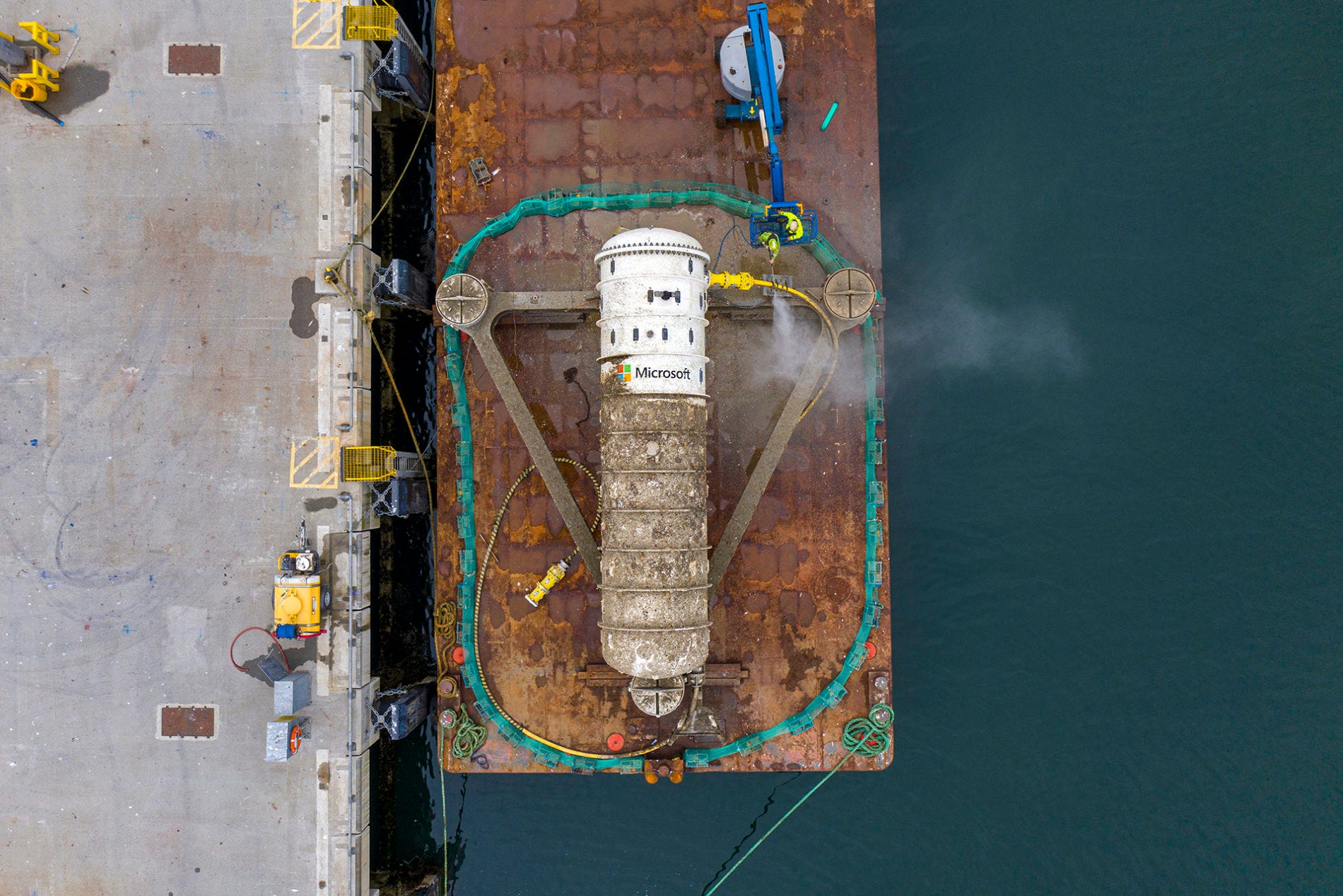
But why go to all the logistical trouble of putting a server-loaded vessel in the ocean when you can just build a data center on land? Though it may sound outlandish at first, placing data centers on the seafloor offers a range of advantages, especially when it comes to solving the challenges that continue to plague land-based builds.
📍 Location
In order to achieve peak computing times, data centers must be near population centers—which tend to cluster around coasts (~half of the global population lives within 100km of a coast). As it turns out, underwater property is much more affordable than coastal (or coastal-adjacent) land. For example, the company Deepwater Wind (now a part of Orsted) leased “a large block of seafloor off the coast of Rhode Island” for $3/acre in 2013,” while in comparison, “agriculture land in the U.S. rents for about $144/acre,” or 48x that amount. Though 2013 was over a decade ago, that difference still represents the gap in prices between ocean “land” and dry land. Not only does this unlock cost savings, but it preserves the land for people rather than large-scale factories.

Additionally, data centers teams have to contend with the climate of the location in which they build—but not under water. A major benefit of sub-sea centers is the predictable ambient conditions. Temperatures on land can fluctuate dramatically, resulting in over-engineered cooling systems that add costs to a center. In contrast, the fluctuations underwater are much more narrow—think ~10oF at most rather than ~90-100oF. Temperatures underwater remain much more stable than those on land.
👥 Proximity to Population
Latency, or the delay between when a consumer clicks a button (user action) and their streaming service or webpage loads (service reaction), is extremely important to consumers. Low latency = good. What stands in the way of low latency? Distance and network congestion. In order to deliver services with low latency, data centers must be within a relatively close proximity to the populations they’re serving, as it is estimated that “every 100 kilometers of travel leads to about one millisecond in latency.”
Nearly half of the global population lives within 100 km of a sea, but coastal and coastal-adjacent land tends to be expensive, crowded, and in high-demand. Putting a data center underwater frees the company of a dependence on this expensive, crowded land and frees up that property for human use.
⏳ Design and Construction → Time to Launch
With underwater pods, there is no need for time-intensive custom buildouts because these data center pods can be uniform regardless of the area they’re serving. The Microsoft team notes that, though terrestrial data center equipment may be relatively uniform from center to center, the “building codes, taxes, climate, workforce, electricity supply, and network connectivity are different everywhere” and require a level of customization—and therefore time—that the underwater centers simply don’t demand. Aside from the cost savings this confers, it also reduces the time from decision to deployment. Microsoft claims that their Natick pods support a 90-day turnaround time.
⚡ Energy Costs
Submerging a data center in cold ocean water certainly keeps cooling costs down. Project Natick (Phase I) was able to keep their energy overhead value to a mere 3% by using heat exchangers in the steel pods that transferred heat into a liquid, pumped that liquid into heat exchangers on the pod’s exterior, and transferred the heat into the surrounding waters. Even in the tropics, cold seawater is easily accessible, so this cooling scheme is effective regardless of location as long as the pods are deployed in water of sufficient depth.
💦 Water Use
Many existing data centers rely on evaporative cooling, a technique that uses a tremendous amount of water. Data centers are already dipping into the pools of potable drinking water, often in the most water-stressed areas, leading to concerns about water scarcity. (Some communities are already taking action to address this). The success of Project Natick proves that a data center can operate in the right conditions (under water) without guzzling ungodly amounts of water, depleting valuable sources of freshwater.
🌎 Sustainability
UDCs can be deployed near offshore sources of renewable energy so that the grids they’re connected to are 100% renewable. Project Natick Phase II was specifically tested in a harsh marine environment and on a renewable grid to prove that this proposition could work even on a grid that may be traditionally deemed unreliable.
🤑 Additional Cost Savings
Beyond the cost savings from all of the points mentioned above, there are additional gains to be had. Putting a sealed data center in the ocean negates many of the ongoing costs that have to do with the upkeep of a data center, including onsite labor and operations. Since no personnel are required to operate the data center on-site day to day, there are meaningful opportunities for cost savings.
But there are certainly challenges specific to marine-based data centers to consider before shouting from the rooftops that we’ve found our silver bullet.
🔥 How will UDCs impact the temperature of the water around them? If the heat from inside the pods is transferred to the surrounding waters, won’t this have a significant warming effect?
Contrary to what I expected, the answer is no, it will not. Microsoft researchers found that water a few meters away from a UDC would, at most, “get a few thousandths of a degree warmer,” while another source claims that, because water is so efficient in dissipating heat, there is no detectable change in temperature more than a meter away from the UDC.
🛠️ What happens when equipment breaks? How easily can it be treated or repaired or swapped out? Is it reliable enough to make this type of deployment economically feasible?
Oxygen causes material to corrode, and human error—the normal bumping, jostling, and nudging of everyday human life—can damage servers in a normal, terrestrial data center. In a sealed steel container under water, neither of these are concerns. In Project Natick, the Microsoft researchers removed the oxygen from the sealed steel pod and filled it with nitrogen, greatly reducing the amount of possible corrosion. And because the steel pod is a server-only environment, there is no possibility of the bumps and jostles that are common in a human-filled space.
The Project Natick team found that they had “eight times fewer failures of the components in the underwater version as we did on land.” This led to their determination that, in environments better suited to technology (without humans), the computers perform better and last longer.
This doesn’t mean, however, that there were no technological failures. One of the key concerns coming out of this experiment is how to identify and properly address tech issues from afar. After all, it would be prohibitively expensive to pull the pod out of the ocean every time there is a glitch or malfunction. This is an issue that Microsoft, along with other tech companies, continues to work on today.
🔐 How will we keep UDCs safe—considering both physical safety and cyber security?
The UDC would be protected from physical threats by sensors and cameras physically, and from cyber threats with the same encryption and security that a terrestrial data center receives. But what about marine life—is there a concern about aquatic creatures somehow damaging the pod? Given the massive dimensions of the steel pod, I don’t think that marine life could physically impair it, and that did not seem to be a concern of the scientists’ in any article I read. They were, however, concerned about biofouling, or the colonization of marine life to create an artificial reef. Which brings me to another concern…
🪼 Will UDCs disturb wildlife?
Because Project Natick’s scientists predicted—correctly—that sea creatures would almost immediately be attracted to the pod’s surface, they sought ways to allow for the necessary heat transfer in and out of the pod without harming the creatures who made the pod’s exterior a home for themselves. They explored a number of methods, including anti-fouling coatings for the pod, but this “remains an area of active research” for the team.
Microsoft researchers found that the UDC was not audibly detectable more than a meter away, assuaging concerns about underwater noise pollution.
So…why don’t we have lots of underwater data centers now?
Despite the success of Project Natick, Microsoft tabled the project and is not (at least publicly), moving it forward. Some sources cited the operational difficulties as the main barrier to expansion; it was just too difficult and costly to service the vessels.
Though Microsoft was at the forefront of the UDC movement, the field has since expanded. Several other companies are currently exploring these uncharted (or barely charted) waters. I’ll get into that in part II.

Great summary thank you!
Fascinating!